https://fanchallenge.thehobbit.com/?entryid=447
Tag Archives: Die Casting Process
The Die Casting Part Production Process Explained.
What is the Die Casting Process? The Die Casting Part Production Process Explained.
Kinetic Die Casting Company uses a manufacturing process called “Die Casting” to make aluminum die casting parts and zinc die casting parts. But, what is the die casting part production process? Here is a GIF image I have on our home page to demonstrate:
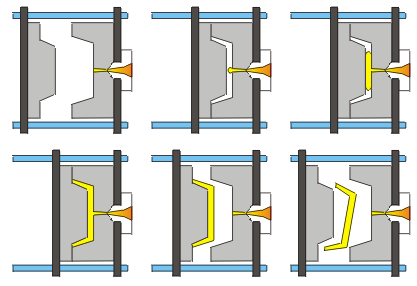
demonstration of the die casting process
“Aluminum die casting is an aluminum metal parts production process where molten aluminum metal alloy is injected into a steel die, under extreme pressure, to manufacture aluminum parts” (Substitute the word “zinc” for “aluminum” in zinc die casting part production process)
Another GIF example example is on this web page:
(click) What is Die Casting?
Another demonstration of the die casting process
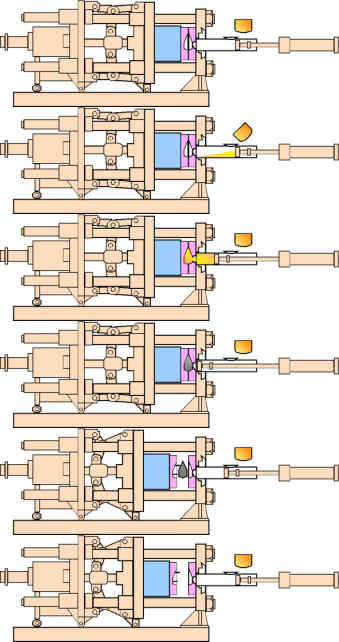
Cold Chamber Die Casting Process
The image pictured above depicts a Cold Chamber Die Casting Machine as it makes parts. The term “Cold Chamber Die Casting” refers to a separate metal melting furnace. The High Pressure Die Casting, cold chamber die casting process follows this sequence:
- Look at the die casting machine image above
- The die casting machine opens the die casting mold.
- The prior part is removed and the die cast mold is sprayed for the next part
- The aluminum is poured using a ladle into a shot cylinder
- The shot piston injects the metal into the die casting mold.
- The machine opens and the process starts again.
Contact Kinetic Die Casting Company for more information about the high pressure die casting process and about how to get great die casting parts at a great price and delivered quickly, no matter what quantity you need.
Kinetic Die Casting manufactures aluminum military parts, aluminum hardware, and aluminum die castings. Visit our website for a quote: Kinetic Die Casting Company
The Pros and Cons of Cold Chamber Die Castings
The Pros and Cons of Cold Chamber Die Castings. Cold chamber die castings utilize Cold Chamber machines to make easy die castings. Cold chamber die casting is one of the two die casting methods. The other one is Hot Chamber castings which sometimes utilizes Hot Chamber zinc castings.
Cold chamber die castings engage the utilize of a metal cylinder where the melted metal alloy is poured. The melted metal then will be pushed by an injection pump into the die cast thus manufactured metallic parts.
Cold chamber die castings allow for the manufacturing of aluminum, zinc, and certain alloys of magnesium. In fact, these outstanding materials for fabricating parts can only use cold chamber die casting methods.
The huge benefit of cold chamber die castings is that the process can make denser metal castings. Denser metal is fashioned owing to the higher pressure utilized during the injection development. Density can also be qualified to higher speed procedure of cold chamber injection. Another benefit of cold chamber die cast manufacturing is its low maintenance cost. Through cold chamber castings, manufacturers can produce more parts with lower overhead costs. This drives down the market prices of aluminum parts.
Cold chamber die castings also have several disadvantages. First, cold chamber manufacturing has slower production cycles. The melted metal in the cold chamber can cool down even before injection. Finally, the melted metal in the cold chamber is barer to oxidation and other contaminants chiefly if the production floor does not have strict quality control.
Cold chamber die castings can offer many advantages for die cast parts manufacturers. The benefits and advantages one can get from the cold chamber method can outweigh its disadvantages. Metals used in cold and hot chamber methods include 380 Aluminum, zinc, and other aluminum alloys.
Kinetic Die Casting is a die casting company specializing in aluminum and zinc parts. If you would like to request a quote, please visit our website:Kinetic Die Casting Company
Die Casting Parts Machining Requirements and Advantages.
Machining Die Casting Parts, Die Casting Parts Machining Requirements and Advantages.
Kinetic Die Casting Company produces many types of die casting parts that are machined as a secondary process, but we also produce many parts that do not need to be machined because we die cast the features into the parts. Here are a few examples of parts that are typically produced as a die casting parts because it saves money to make them as die castings.
HEAT SINKS –
Heat sinks in the past were always extruded in aluminum because aluminum is one of the best materials for heat conductance (more info) but the extrusions creates a lot of waste material and the additional cost to chop the heat sinks to length and machine mounting holes.
These reasons make die casting aluminum a far superior manufacturing process. Aluminum Die Castings are produced to the size and shape necessary with no wasted material. Die casting heat sink parts do not require additional machining to “chop” to size. Mounting holes are produced during the manufacturing process at no additional cost.
SAND CASTINGS
Sand castings cannot maintain the tolerance that die castings typically hold. Sand castings need a greater amount of variance from feature to feature. Many times a sand casting part will require machining in an interior section of a part between features because the tolerance is greater than .002″ (about half the thickness of paper)
See our website:
• Die Casting Heat Sinks
• Sand Casting Information
Contact:
Kinetic Die Casting Company 818-982-9200 for more information or to get a price of a die casting part to replace a current heat sink or sand casting part.
Kinetic Die Casting manufactures zinc and aluminum die casting. If you would like a quote, please visit our website:Die Casting quote
Posted in Die Casting Parts
Tagged Aluminum Heatsinks, aluminum parts, Die Casting Process, Heat Sinks, Sand Casting
1 Comment
Kinetic Die Casting Company makes Superior Quality Aerospace Die Castings.
Our customer recently sent us a die casting tool to produce die casting parts. He recently experienced a reject from his customer and he needed our help.
Honeywell Aerospace (aerospace company) uses a quality inspection document, EMS 230, to accept or reject high pressure die casting parts. Our customer supplied die casting parts to Honeywell and these castings were rejected for “Cold Shots”.
Cold Shots are imperfections in the metal flow into die casting parts due to the metal freezing or solidifying prior to the metal filling the die casting cavity. It usually happens when the metal flow is limited or the metal is not the proper temperature or the die casting mold is not the proper temperature. As a great quality die casting company, we solve these issues every week. We control the metal temperature with thermocouples and we control the die temperature in our die casting process.
It can also happen if the die casting tooling or the die casting part is poorly designed. The die casting process needs metal to flow rapidly into the die casting tool to make solid die casting parts. Design of the tool or part can limit that fluid process.
This is what happened in this case:
* The die casting tooling gates into a section of the die casting part of about 0.030″ thick wall thickness. This is thinner than recommended for the metal to flow into the die casting. This restricts the metal flow.
* There are sections of the die casting that are over .200″ thick. Consistent wall thicknesses are critical for sound die castings.
* The prior die casting company added overflows and vents that worked against each other by filling the tool from two or three directions. These gates, vents and overflows created turbulence in the shot process which cause the metal to cool prematurely.
What did Kinetic Die Casting Company do for our new customer?
* We made some fast tooling changes to improve the metal flow in the die casting tool.
* We made great quality die casting parts for our new customer.
* We did this in less than three weeks for our happy customer.
Like Us  Join Us
 Follow Us
Contact Kinetic Die Casting Company for your metal products. 818-982-9200 or sales@kineticdc.com
Kinetic Die Casting can manufacture aluminum automobile parts, heat sinks, aerospace parts and much more. If you are looking for aluminum or zinc parts, visit our website Kinetic Die Casting Company
Exploring the Process of High Pressure Die Casting
Exploring the Process of High Pressure Die Casting. The process of high pressure die casting is one of the fastest and cost effective methods in shaping metal products. Many manufacturing companies in the fields of automotive, aircraft and electronics use die casting as the primary metal working procedure. It produces high quality products with strong yield and fine finish. It provides strength treatment which is far better than forging, extrusion or sand casting.
The procedure involves two dies: the cover die half and the ejector die half. Between them is the mold cavity. When the dies are fitted together, the plane of intersection is called the parting line. During metal working, molten metal is forced to the mold through an opening in the cover die. This is done with very high speeds, due to the high pressure of injection. These are called “shots.” While the metal is still in liquid form, extreme pressure is applied, compressing the dies. This will be maintained until the metal solidifies.
The process of high pressure die casting is further divided into two groups: cold chamber and hot chamber processes. Basically, both employ high pressure shooting and compression of the molten metal. However, hot processes can only be used on metals with lower melting point. These include copper. Cold processes are used on high melting point metals like aluminum and magnesium. Cold processes take a relatively longer time before the shot is compressed at the dies.
In both methods, the process of high pressure die casting is consistent in producing tough products. They are highly resistant to torsional and tensional stresses, making die casting popular in multiple industries.
To get a price for aluminum die casting parts or die casting tooling, call toll free 800-524-8083 and ask for sales. Or email us at sales@kineticdc.com for a fast response on a price quote.