Aircraft or better known as Airplanes are large, very large. They are large because they are designed to carry things, lots of things. Airplanes carry mail, gifts, shipments, food, packages, baggage, and people. Airplanes are the fastest transportation for “things” …
Continue reading
Tag Archives: #kineticdc
Get 500 Die Casting Parts Today
Thank you for being our Kinetic Die Casting parts customer. Kinetic Die Casting Company makes parts for our manufacturing customers using the die casting process. What that means is, we inject molten metal into a steel die mold to make metal parts. When the die casting mold is in the die casting machine, the die casting process to make metal parts is very fast.
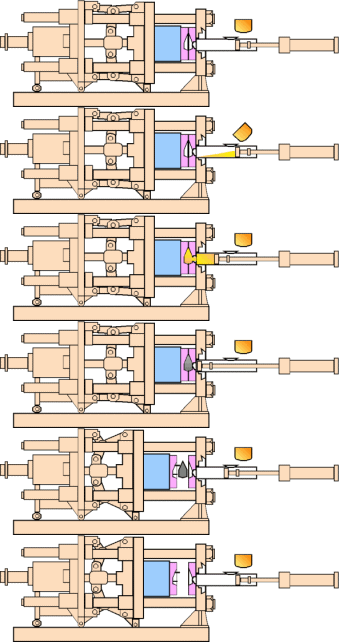
Die Casting Process
Get 500 Die Casting Parts Today
It goes like this:
In this way, we make 60 parts for our customer every hour and about 500-600 parts in a 10 hour work shift.
“The Parts We Make Today, We Ship Today”
Kinetic Die Casting Company. Inc.
6918 Beck Avenue, North Hollywood,
California 91605, United States of America
E-mail sales@kineticdc.com
USA Toll Free: (800) 524-8083 Local: (818) 982-9200
To get prices for Die Casting Parts:
Quote Prices Die Casting Parts
Kinetic Die Casting Company makes:
Aluminum Die Casting Handle Hardware
Different Types of Die Casting Alloys
Permalink: https://www.kineticdiecasting.com/kdc/process-500-die-castings-a-day/
Die Casting Tooling 101
Commercial Die Casting 101: Tooling Made for Die Casting. Nowadays, die casting is popular choice for metal-working in large scale productions. sales@kineticdc.com Modern automotive, aircraft and related industries require metal parts that are tough and durable. Die casting, other than being a shaping process, is inherently a metal treatment. The final product exhibits high yield and resistance to multi-directional loading. Here is a set of components and tooling made for die casting:
The most important elements in the method are the dies. A pair of cover and ejector halves is required to start the process. They contain the shape that the molten metal will follow. Unlike other types of casting, dies can produce very detailed pieces in just one processing. However, these parts must be kept clean and lubricated on every operation.
The cover die has an opening that receives the molten metal. It must be carefully lubricated so that the final product will be smooth. Another tooling made for die casting is the set of ejector pins, which are connected to the ejector die. They facilitate quick dropping of the solidified metal. In traditional methods like sand casting, you have to remove the final products from the mold manually.
Another important tooling made for die casting is the fluid line system. Water lines are used to feed water into the machine during compression. Water serves as lubricant and coolant to the contacting parts. Gas escape lines, on the other hand, allow gas to escape from the metal during shaping. If gasses are not allowed to escape, gas bubbles may be trapped in the finished product. Gas bubbles are indicators of high porosity, making the piece weaker to tensional stresses.
To get a price for aluminum die casting parts or die casting tooling, call toll free 800-524-8083 and ask for sales. Or email us at sales@kineticdc.com for a fast response on a price quote.

Kinetic Die Casting is a die casting company specializing in aluminum and zinc parts. If you would like to request a quote, please visit our website:Kinetic Die Casting Company
https://www.kineticdiecasting.com/kdc/commercial-die-casting-101-tooling-made-for-die-casting/
Posted in Blogger, newsletter, Tooling Die Casting
Tagged #diecasting, #kineticdc, die casting tooling, Tooling Die Casting
Leave a comment
Zinc Die Cast Auto Parts
Zinc die cast auto parts have revolutionized the automotive industry, offering a perfect combination of durability, precision, and cost-efficiency. As a popular choice for manufacturing various automotive components, zinc die casting provides exceptional strength and corrosion resistance that meet the high demands of the automotive sector.
The process of zinc die casting involves injecting molten zinc metal under high pressure into a steel mold cavity, allowing intricate and complex shapes to be produced with excellent dimensional accuracy. This manufacturing method enables the production of auto parts with thin walls, fine details, and tight tolerances, making zinc die casting a preferred option for a wide range of automotive applications.
One of the key advantages of using zinc die cast auto parts is their superior strength-to-weight ratio. Zinc alloys, such as Zamak, offer high strength and rigidity, making them ideal for producing lightweight yet robust components for automotive vehicles. This strength ensures that zinc die cast auto parts can withstand the rigors of daily use, providing long-lasting performance and reliability.
In addition to their strength, zinc die cast auto parts also exhibit excellent corrosion resistance, making them well-suited for use in various automotive environments. The inherent properties of zinc alloys prevent rust and deterioration, ensuring that auto parts remain in optimal condition even under harsh conditions like exposure to moisture, chemicals, or temperature fluctuations. This corrosion resistance enhances the longevity and durability of zinc die cast auto parts, making them a cost-effective choice for automotive manufacturers.
Furthermore, zinc die casting offers exceptional design flexibility, allowing auto parts to be produced in a wide range of shapes and sizes to meet specific performance requirements. The ability to create intricate geometries and complex features through zinc die casting enables automotive designers to optimize product designs for functionality, performance, and aesthetics. This versatility in design allows for the production of customized auto parts that can enhance the overall performance and appearance of vehicles.
Another significant advantage of zinc die cast auto parts is their cost-efficiency. The high productivity and repeatability of the die casting process result in lower production costs compared to other manufacturing methods. The fast cycle times and minimal post-processing required for zinc die casting further contribute to reducing overall production costs, making it an economical choice for automotive manufacturers looking to maximize efficiency and profitability.
Additionally, the recyclability of zinc alloys used in die casting makes zinc die cast auto parts an environmentally sustainable option for automotive applications. Zinc is a fully recyclable material that can be melted down and reused without degradation in quality, reducing the environmental impact of manufacturing processes and promoting a circular economy approach within the automotive industry.
In conclusion, zinc die cast auto parts offer a winning combination of strength, durability, corrosion resistance, design flexibility, cost-efficiency, and sustainability that make them an ideal choice for automotive manufacturers. With their unmatched performance and reliability, zinc die cast auto parts play a crucial role in enhancing the safety, efficiency, and overall quality of vehicles on the road.
“The Parts We Make Today, We Ship Today”
Kinetic Die Casting Company. Inc.
6918 Beck Avenue, North Hollywood,
California 91605, United States of America
E-mail sales@kineticdc.com
USA Toll Free: (800) 524-8083 Local: (818) 982-9200
To get prices for Die Casting Tooling Molds or Parts:
RFQ Die Casting Tooling Part Prices
Kinetic Die Casting Company makes:
Metal Casting Parts or Plastic Parts
 Military Die Casting Parts
Die Casting Tooling
Permalink: https://www.kineticdiecasting.com/kdc/zinc-die-cast-auto-parts/
Posted in Auto Parts, Blogger, Die Casting Parts, newsletter
Tagged #AutoParts, #CarParts, #diecasting, #kineticdc, #Zinc, #ZincDieCasting, #ZincParts, automotive
Leave a comment
Fixing Porosity In Die Casting Parts
Solving Problems of Die Casting Porosity in Die Casting Parts. Porosity in die casting parts is an important issue in metal-working. Porosity, in the science of materials, refers to the presence of gaps or bubbles inside a metal structure. High porosity tends to weaken the final product. Metal parts production companies are given certificates depending on strength, durability and reliability of their products. Hence, this defect must be minimized.
Fixing Porosity In Die Casting Parts
To fully understand this concept, one must be aware of the metal-shaping process behind it. Die casting is a method that uses high pressure to shape a molten metal. For example, zinc is heated on a furnace to reach its melting point. Then, it will be shot to fill the gap between two dies. That gap is the mold, which contains the shape and details of the final product. As the lump of zinc solidifies, pressure of up to 175 mega Pascal is exerted through the dies. If gases are accidentally mixed during this speedy process, they will result in porosity in die casting parts.
There are three levels of die casting porosity in finished metal parts. The first two levels are acceptable, depending on the expected usage of the part. The third level means that the object is highly porous. There are large gas bubbles inside that will weaken the product against tension.
Most of the time, it is impossible to achieve a 100% pure metal piece if die casting is used. Porosity in die casting parts can be minimized by thoroughly cleaning the dies before operations. Pressures and temperatures must also be matched with the type of metal and intended purpose of the part.
To get a price for aluminum die casting parts or die casting tooling, call toll free 800-524-8083 and ask for sales. Or email us at sales@kineticdc.com for a fast response on a price quote.
Kinetic Die Casting is located in Southern California. KDC specializes in aluminum and zinc die casting tooling. If you would like a quote, please visit our website:Kinetic Die Casting Company sales@kineticdc.com
Posted in Blogger, Diecasting Process, newsletter
Tagged #diecasting, #DieCastingPorosity, #kineticdc
Leave a comment
The Advantages of Aluminum Die Casting
Aluminum die casting is a widely used manufacturing process that offers numerous advantages over other casting methods. This versatile technique allows manufacturers to produce intricate and complex components with exceptional precision and cost-effectiveness. In this post, we will explore the advantages of aluminum die casting and understand why it is favored by industries worldwide.
Lightweight and Strong:
Aluminum is renowned for its excellent strength-to-weight ratio. Components produced through die casting are remarkably lightweight while maintaining high structural integrity. This advantage makes aluminum die casting ideal for applications in the automotive, aerospace, and consumer electronics industries, where weight reduction is crucial for fuel efficiency and performance.
Design Flexibility:
Die casting offers designers and engineers a high degree of freedom in component design. The process allows for the creation of complex shapes, intricate details, thin walls, and sharp angles that may be challenging to achieve with other casting methods. The versatility of aluminum die casting enables the production of aesthetically pleasing and functional components, giving manufacturers a competitive edge in the market.
Excellent Surface Finish:
Aluminum die casting results in parts with a superior surface finish. The process minimizes the need for secondary operations such as polishing or painting, reducing overall production costs. The smooth and uniform finish obtained through die casting enhances the visual appeal of the components, making them suitable for applications where appearance is crucial.
Cost-Effective:
Aluminum die casting is a cost-effective manufacturing process. High-speed production enables manufacturers to produce large quantities in a short timeframe, leading to economies of scale. The tooling costs associated with die casting can be recovered quickly due to the high productivity and efficiency of the process. Moreover, aluminum die casting machines have long service lives, further reducing production costs in the long run.
Superior Thermal Conductivity:
Aluminum possesses excellent thermal conductivity properties, making it suitable for applications where heat dissipation is critical. Components produced through aluminum die casting efficiently transfer heat, ensuring optimum performance and preventing overheating. This advantage makes it a preferred choice in industries such as automotive, LED lighting, and electronics.
Aluminum die casting offers a wide range of advantages that make it a preferred choice for manufacturers worldwide. From its lightweight and strong properties to its excellent surface finish and thermal conductivity, this manufacturing process provides unmatched design flexibility and cost-effectiveness. Ultimately, aluminum die casting helps companies produce high-quality components that meet the demands of modern industries.
“The Parts We Make Today, We Ship Today”
Kinetic Die Casting Company. Inc.
6918 Beck Avenue, North Hollywood,
California 91605, United States of America
E-mail sales@kineticdc.com
USA Toll Free: (800) 524-8083 Local: (818) 982-9200
To get prices for Die Casting Tooling Molds or Parts:
RFQ Die Casting Tooling Part Prices
Kinetic Die Casting Company makes:
Metal Casting Parts or Plastic Parts
Die Casting Tooling