Aluminum diecaster Quad City to permanently close plants July 12 Washington (Platts)–14May2009 US aluminum diecaster Quad City Die Casting will permanently close its three plants on July 12, and recently sent out a Worker Adjustment & Retraining Notification notice to …
Continue reading
Category Archives: Die Casting Parts
Kinetic Die Casting Makes Aluminum Chassis Castings
Kinetic Die Casting Makes Aluminum Chassis Castings. The internet contains tons of websites that can offer you information about anything under the sun, so if you’re looking for information on aluminum die casting and chassis castings, one of the best websites to recommend is Kinetic Die Casting. Here, you’ll find all the information you need regarding, die casting, aluminum die casting in particular, and of course articles on aluminum chassis casting. The company even offers their services to people in need of aluminum chassis castings.
Chassis refers to the frame, machinery, and even the wheels of a motor vehicle, an electrical component, and even of musical instruments like an electric guitar. The chassis part is what holds the body of the instrument or vehicle together, and the use of aluminum to create the housing or the parts has long been used by many manufacturers of the industry today. If you read through the articles of Kinetic Die Casting, you’ll discover that aluminum, compared to steel and other alloys, is the most common and popular because of how lightweight it is, how durable and strong the material is, and of course how quick it is to produce. Aluminum chassis casting also means being able to shape the parts or the housing in such a way that it is more complex, more tolerable, and shapely at the same time.
Kinetic Die Casting manufactures custom metal parts to their customer. If you would like more information about Kinetic Die Casting, please visit our website:Kinetic Die Casting Company
Posted in Die Casting Parts
Tagged aluminum parts, Chassis, Die Casting Parts, Die Castings
Leave a comment
Die Casting Aluminum Military Parts vs Extrusions
Pressure Die Casting Aluminum Military Parts vs Extrusions. Die casting is a process wherein molten aluminum is injected into a mold with great pressure. Afterwards, they are then set to water cool. When they are opened, they are then ejected. Aluminum military parts are created through this simple and inexpensive manufacturing process. As compared to other processes like sand casting, gravity casting, forging, extrusion, plastic injection moldings and stamping, die casting is inarguably the most efficient process for molding aluminum military parts.
Pressure die casting parts are more recyclable as opposed to forgings and extrusions. Aluminum die casting is efficient and economical when it comes to maintenance, refurbishing, remanufacturing, and repair for extending its life. It is non toxic and practical, and can readily be used again and again.
Pressure die casting is produced faster compared to extrusions. It has more net shape, which means that more features, depressions and angles can be placed in one operation. You can create more complex shapes, have thinner sheets, and more accurate dimensions with high pressure die casting for aluminum military parts. Holes can be cast in place rather than machining them later, adding to a higher production cost. There will be fewer waste products in pressure die casting aluminum military parts as opposed to extrusions.
Kinetic Die Casting is a aluminum and zinc die casting company. If you would like to know more information, please visit our website:Kinetic Die Casting Company
Posted in Die Casting Parts
Tagged Aluminum Die Casting, Military Die Castings, Military Parts
Leave a comment
Customer Multiplied Total Sales 5x
About ten years ago, two men named “Brian” and “Ron” working for a machining company in Orange County, California contacted Kinetic Die Casting Company to quote a “Project” for a simple die casting tool to produce from 5,000 to 23,000 sets of parts.
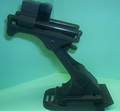 Each set would make up a “Night Vision Goggle Device”.
These sets consisted of seven (7) separate parts; the machining company would machine and assemble.
Brian needed these parts delivered very fast. The cost of the tooling needed to be inexpensive in order to be competitive.
We decided to make a “unit die tool” because of the low quantity potential and chose a good toolmaker in the Los Angeles area to make the tool. We opted to trim the parts with a simple “push through trim die” and to hand finish the parts. In order to make the tooling, we used 3D files from their Mastercam to produce IGES files. We added the shrinkage and draft necessary in order for the die casting tool to function properly.
The project went very well. In fact, Brian won additional contracts to produce more Night Vision Goggles. For a few years we were producing up to 5,000 sets or 35,000 parts every week. For three years straight this company was our top customer company and for five years a very good customer indeed.
At the project conclusion Kinetic Die Casting Company had produced over 400,000 sets of parts or 2,800,000 parts from that simple die casting tool for our good customer. This was a huge success for our customer because they grew in sales over 5x in those five years.
Citation Buys Iowa-Based Blackhawk Closes Plant
Citation Buys Iowa-Based Blackhawk, Will Allow Plant to Close – Released on November 30, 2009 –
Citation Corp., Novi, Mich., announced it has acquired Blackhawk Foundry & Machining Co., Davenport, Iowa, but will not maintain the plant’s operations.
According to a press release issued by Citation, Blackhawk’s Davenport facility will be closed by its current owners. Citation will acquire the company’s customer contracts and some equipment, which will be transferred to three of Citation’s facilities in Berlin, Wis., Bessemer, Ala., and Biscoe, N.C., by February 2010.
“Our focus continues to be on further strengthening our diversification strategy,” said Citation President and Chief Executive Officer Doug Grimm. “The Blackhawk acquisition further enhances our market diversification.”
In addition to the Blackhawk purchase, Citation announced the sale of its Albion, Ind., machine shop, a 68,000-sq.-ft. facility with 25 employees that primarily manufactures marine engine manifolds, to Busche Machine.
“The sale of our Albion facility allows us to concentrate on our core iron casting and machining capability,” Grimm said. “The Albion business fits better with Busche Machine’s principal products, markets and manufacturing footprint. We’re accelerating our effort to concentrate on core iron casting and machining, which includes our 250,000-sq.-ft. Menomonee Falls, Wis., facility that has 180 machining centers and employs 150 people.”
According to Grimm, Citation has reset its business model to reflect the global economic changes that have occurred during 2009. Citation is a privately held corporation that employs 1,100 at 10 manufacturing facilities. The company designs, develops and manufactures components for the transportation and industrial markets.
“A vast majority of the Blackhawk business is in the agriculture, energy, military and construction markets, which further bolsters our balance of industrial and transportation customers,” Grimm said.
Kinetic Die Casting Company can manufacture aluminum car parts, aluminum hardware, and Aluminum Lighting Partsaluminum lighting parts
Why should you use Die Cast Heating Plates?
Why should you use Die Cast Heating Plates? Die Cast Heating Plates are used for many industrial purposes. Examples of their uses include the manufacture of toys, plumbing, cell phones, computers, automobiles, machines and kitchen metal parts. Unknown to many, die casting plates are used for almost every important thing in our day to day lives.
One good example of a Die Cast Heating Plate at work is a chocolate fountain. Chocolate fountains are often used in parties, receptions and other important events. The heater plate keeps the chocolate warm and flowing for several hours.
Generally, Aluminum Die Cast Heating Plates are favored by the general public, preferred by both in households and business establishments. Die casting offer better quality than by other manufacturing processes such as stamping, mold casting, forging and extrusion.
Why should you use Die Cast Heating Plates? The most obvious reason is that the metal used, aluminum, is one of the most copious metals on earth. Since aluminum supply is almost unlimited, the metal is affordable compared to other metals. It also has plenty of advantageous characteristics. It is lightweight, making the production process easier and faster. Its no surprise why many companies opt for this method compared to other more costly methods.
Kinetic Die Casting manufactures a lot of aluminum rooftile plates , trim tile molds, and military die casting. If you would like a quote, please visit our website: Kinetic Die Casting Company